
Hancock Projected Versus Actual Release
A projected, tentative, release-eligibility, or sentence-expiration date is a calculation. It is not the gate event. The label matters because each date answers a different question. Release eligibility can mark the first point when a person may be considered for parole under the controlling law. Sentence expiration marks the calculated end of a term. Actual release is the physical exit recorded by the jail or TDOC after all orders, holds, conditions, and administrative steps are resolved.
A Hancock County pretrial detainee generally has no sentence-based projected date. Release may depend on bond, recognizance, dismissal, case resolution, or a new court order. Even then, another warrant or detainer can stop community release. A detainer is a request or legal hold from another authority. For a sentenced local inmate, the judgment, court-awarded jail credit, and jail calculation matter. For a TDOC felony sentence, FOIL and TDOC Sentence Information are the right state channels.
- Eligibility date
- The earliest statutory point at which a person may qualify for release consideration.
- Sentence expiration
- The calculated end of the sentence after controlling rules and credits.
- Actual release
- The recorded date and time a person physically leaves that custodian.
- Detainer
- A hold that may cause transfer to another authority instead of community release.
Find Hancock Projected Release Dates
Begin by deciding whether the person is held by Hancock County, serving a TDOC sentence, or in another system. A name disappearing from the Hancock County Jail does not resolve that question. It can mean bond, sentence completion, transfer to TDOC, another county, federal custody, or immigration custody. The legal custodian determines which calculation and records apply.
- Collect the full name, booking or offender number, court case number, booking date, and sentencing court. Use a stable ID when available.
- For a Hancock County Jail case, call the jail and ask whether the person is pretrial or sentenced. Request the judgment-based release computation, actual jail credit, and any known hold.
- Ask the Hancock Circuit Court Clerk for the judgment, sentence, amended orders, and jail-credit notation. A court order date may differ from jail processing time.
- For a state felony case, search TDOC FOIL by TDOC ID, SID, or name. Record the exact status and date labels shown.
- If FOIL is unclear, contact TDOC Sentence Information or Records Management. Do not calculate a date from sentence length alone.
- After the stated date, confirm actual release with the custodian or a verified custody event. If the person transferred, follow the receiving agency.
The Hancock County released inmate search path explains how the jail record and court or state record work together after the person leaves the roster.
Note: A county release to TDOC, USMS, ICE, or another jail is a transfer, even if the Hancock booking closes that day.
Hancock FOIL Release-Date Search
FOIL is the durable state lookup for felony offenders now or formerly in TDOC custody or supervision. Search by TDOC ID or SID when possible. A name search accepts last and first name, optional alias matching, and race as a narrowing field, followed by a CAPTCHA. TDOC says results may include a photograph, status, location, offense, sentence data, parole-hearing status, and release information. The word “may” is important because the public search does not promise one universal field on every detail record.
| FOIL item | How to read it |
|---|---|
| Status | Incarcerated means the person is not a released state prisoner. Probation or parole means out of confinement but still supervised. Inactive generally means no active TDOC custody or supervision. |
| Location | Shows the reported institution or supervision placement and helps separate namesakes. |
| Sentence information | Provides context for the date calculation; it does not replace the judgment. |
| Release information | Transcribe the exact label and date shown. Do not rename eligibility as actual release. |
| Parole-hearing status | Shows process information, not proof of a grant or physical exit. |
The successful manifest capture links to the official TDOC FOIL search.
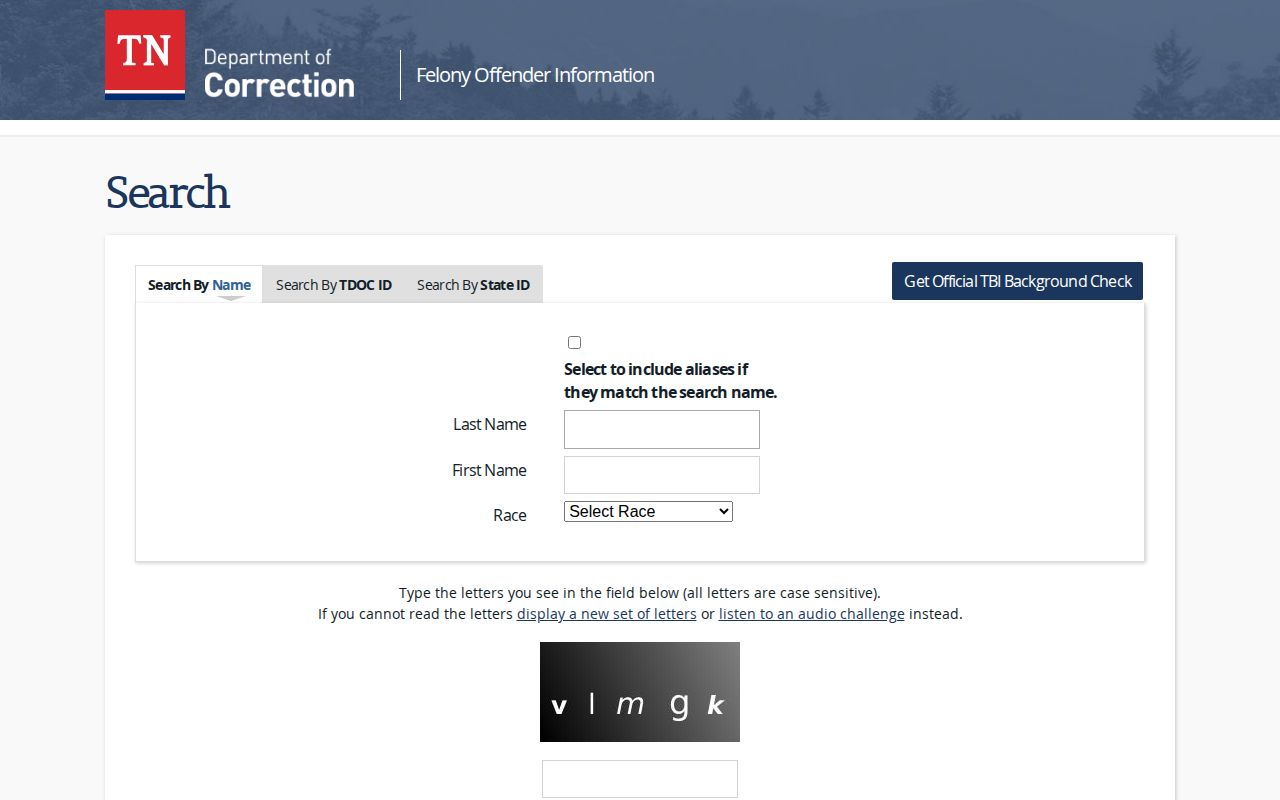
The fields make identifier-based searching more reliable than assuming that two people with the same name share one sentence record.
Hancock Release Eligibility Rules
Tennessee does not have one universal “85% rule.” Tennessee Code § 40-35-501 uses offense dates, felony classifications, offender ranges, and special offense provisions. Depending on the sentence, a person may have an eligibility percentage, be required to serve 85% or 100%, lack release eligibility, or receive credits only down to a set floor. The controlling judgment, offense date, statute version, and TDOC calculation must be reconciled.
Ordinary felony classifications include baseline percentages such as 20% or 30% for an especially mitigated offender, 30% for Range I, 35% for Range II, 45% for Range III, and 60% for a career offender. Special provisions can override those baselines. Certain cohorts and crimes involve an 85% point with a 70% floor, while some offenses committed after July 2022 require 100% service or limit how credits affect eligibility. These examples show why a one-line calculator would mislead.
The source image is a capture of the Tennessee release-eligibility statute.
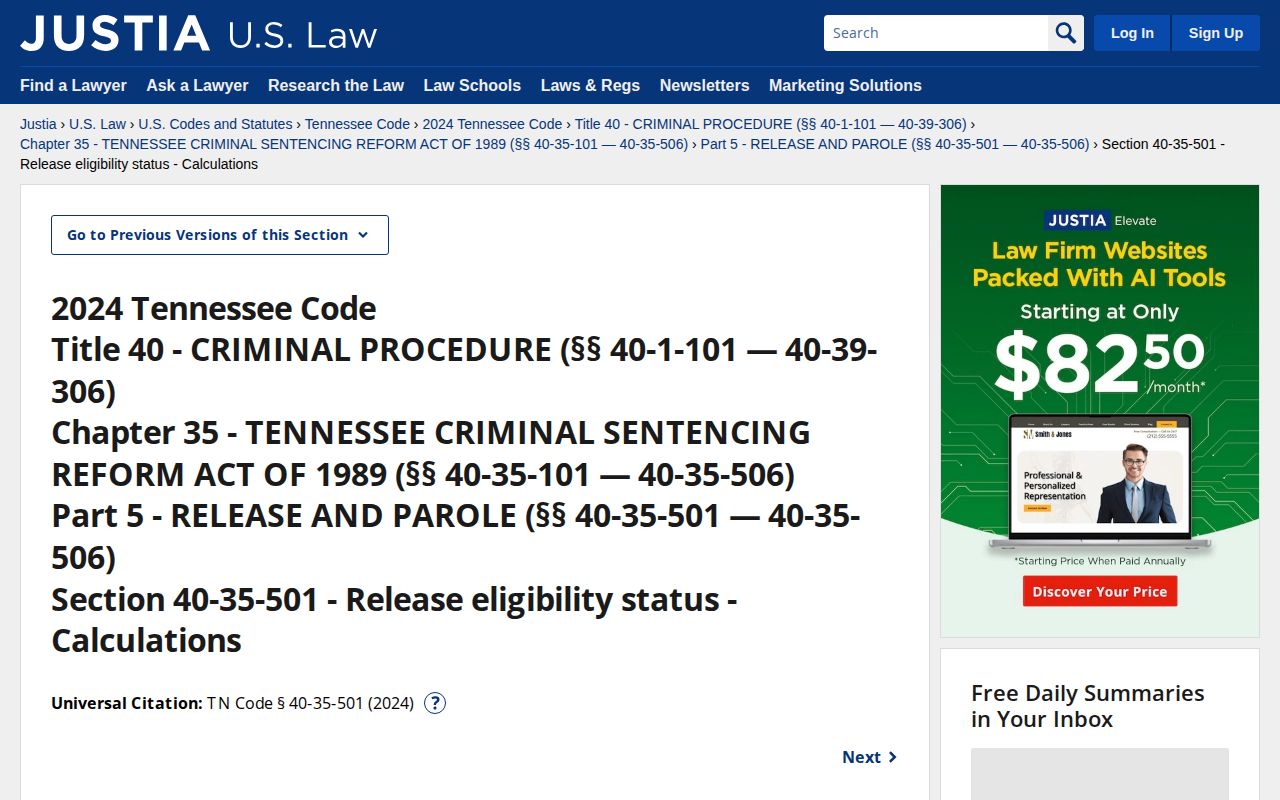
Its offense- and date-specific structure is why TDOC or the jail must supply the calculation rather than a generic percentage.
No Hancock Good-Time Formula
Tennessee Code § 41-21-236 governs TDOC sentence-reduction credits. Credits may be earned and can be lost or withheld. Their effect depends on the sentence law that controls the case. Credits do not create a parole grant, cancel a consecutive sentence, erase a detainer, or prove physical release. For some offenses, credits alter an eligibility calculation within a limit but do not change sentence expiration.
County jail credit is different. A court may award credit for time already served, and the jail applies the relevant local sentence computation. No Hancock-specific good-time policy was verified. No official weekend or holiday early-release rule was found either. Ask the Circuit Court Clerk for the judgment and jail-credit notation, then ask the jail for its calculated date. Avoid promising a Friday exit when a date falls on a weekend.
A useful request names the existing inputs instead of asking staff to predict an outcome. Seek the judgment, any amended judgment, the court's jail-credit entry, the jail or TDOC sentence computation, the precise eligibility or expiration label, and any active hold that affects the exit. Ask whether the stated date assumes credits that can still be lost. This method preserves the agency's own calculation and avoids applying one percentage to a sentence with an offense-specific exception.
Consecutive terms also require care. They run in sequence, and ineligible periods may need to be combined under state rules. An amended judgment, corrected credit, or later sentence can change the inputs. The public date should never be treated as fixed when the underlying record is still under review.
Note: Hancock County has no verified local formula that can safely replace the jail's or TDOC's own sentence calculation.
Why Hancock Release Dates Change
A displayed date can move for legal, credit, custody, or data reasons. Some factors change the sentence calculation itself. Others leave the date on paper but prevent a community exit. That difference is vital when a person has a pending case or another agency hold.
| Factor | Effect on the release path |
|---|---|
| Court jail credit or amended judgment | Changes the start date, credit, or sentence inputs used by the jail or TDOC. |
| Earned credits | May move an eligible calculation earlier within the controlling statutory limits. |
| Credit loss or discipline | Can move a date later or remove credit that had been expected. |
| Consecutive sentence | Requires another term to be served in sequence. |
| Detainer or pending charge | Can prevent release to the community and lead to immediate transfer. |
| Parole decision | Eligibility permits a hearing; a grant, denial, deferral, or rescission changes the route. |
| Data correction | FOIL may update after TDOC reviews a sentence or record mismatch. |
A Board grant still requires an approved release plan and completed pre-release conditions. A court dismissal may not free someone who has another charge, warrant, or sentence. Ask whether the person has physically left and whether another agency assumed custody.
Hancock Mandatory Reentry Release
TDOC describes determinate release for qualifying felony sentences of at least one year and no more than two years after at least 30% service, subject to notice and objection procedures. That is a specific statutory route, not a rule for every Hancock sentence. TDOC also explains mandatory reentry supervision under Tennessee Code § 40-35-506 for felony offenses committed on or after July 1, 2021, with statutory limits and exceptions.
Eligible people may serve the last year in the community when the governing criteria are met. TDOC identifies factors including parole eligibility, proximity to sentence end, no active detainer or pending charge, custody level, recent disciplinary history, and return-to-custody timing. If community placement is unavailable, supervision may follow expiration instead. The exact TDOC determination controls.
The manifest image comes from the official text of the mandatory reentry supervision statute.
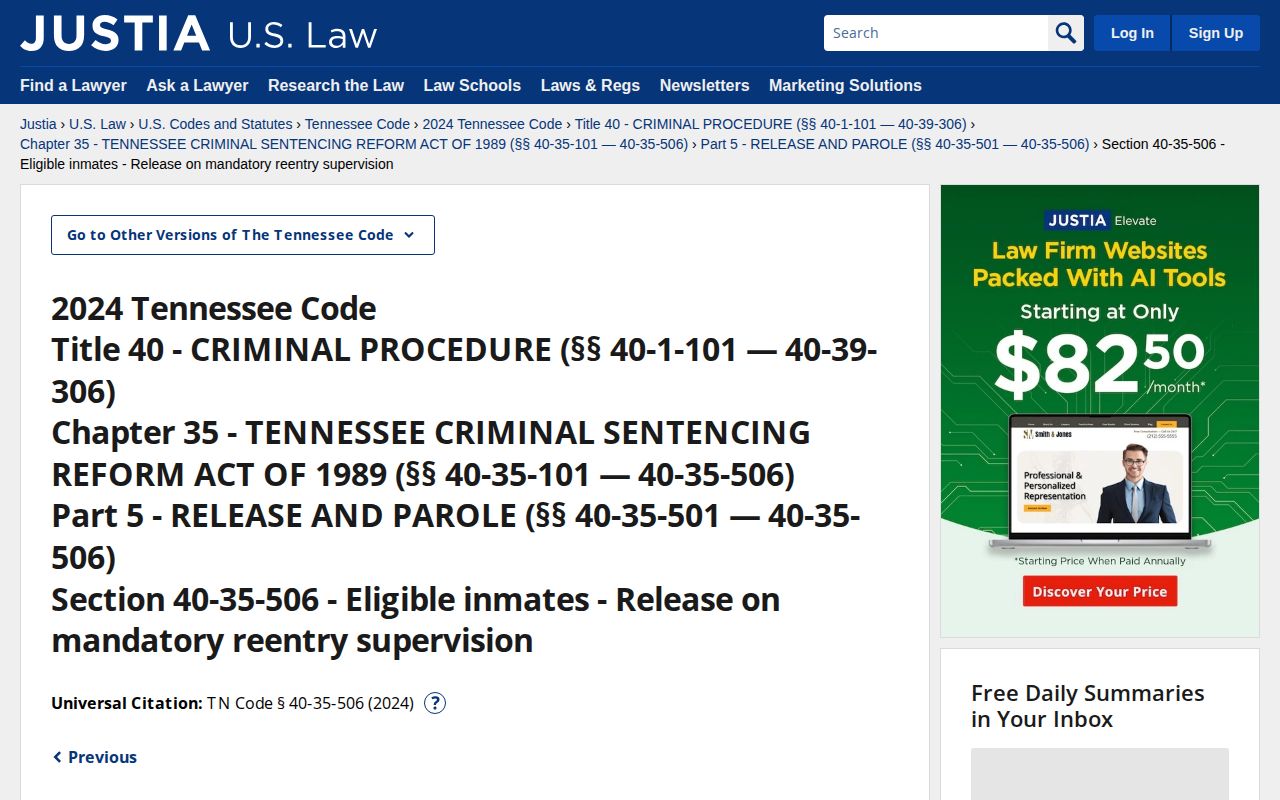
It shows why a release date can begin a new phase of supervision rather than mark the end of the sentence.
Confirm Hancock Actual Release Dates
Confirmation happens after the event. For a local booking, ask the Hancock County Jail for actual release date, time, type, and destination. Pair that answer with the court order that explains the exit. For a state sentence, read the FOIL status and release information, then contact TDOC when the labels remain unclear. Probation or parole status means the person left confinement but remains under supervision.
VINELink Inmate Search can provide a custody alert when the relevant agency feeds Tennessee VINE. Hancock jail participation was not specifically verified, though TDOC coverage is official. A VINE event depends on agency data and is not the legal release order. A no-result also proves nothing by itself.
For a federal sentence, use the BOP locator and federal judgment. For a possible immigration handoff, use ICE's locator. A person “not in BOP custody” or absent from ICE search may be in another system. The reliable endpoint is two-source reconciliation: the releasing agency's event plus the court, TDOC, or receiving-agency record that explains what followed.
Note: Never count down to a projected Hancock County date as if it guarantees a community release at a fixed hour.